A read for CIOs, data leaders, transformation sponsors, and architects who have experienced the gap between the AI roadshow and the AI reality.
Most AI programmes begin as technology initiatives.
They quickly reveal themselves as something else entirely.
Data ownership debates. Governance questions. Integration constraints. Data quality issues that have quietly existed for years suddenly becoming impossible to ignore.
The model, it turns out, is usually the easy bit.
What organisations often discover somewhere between the executive AI briefing and the first production deployment is that the real work was never about building a model. It was about the infrastructure and organisational discipline required to make the model trustworthy.
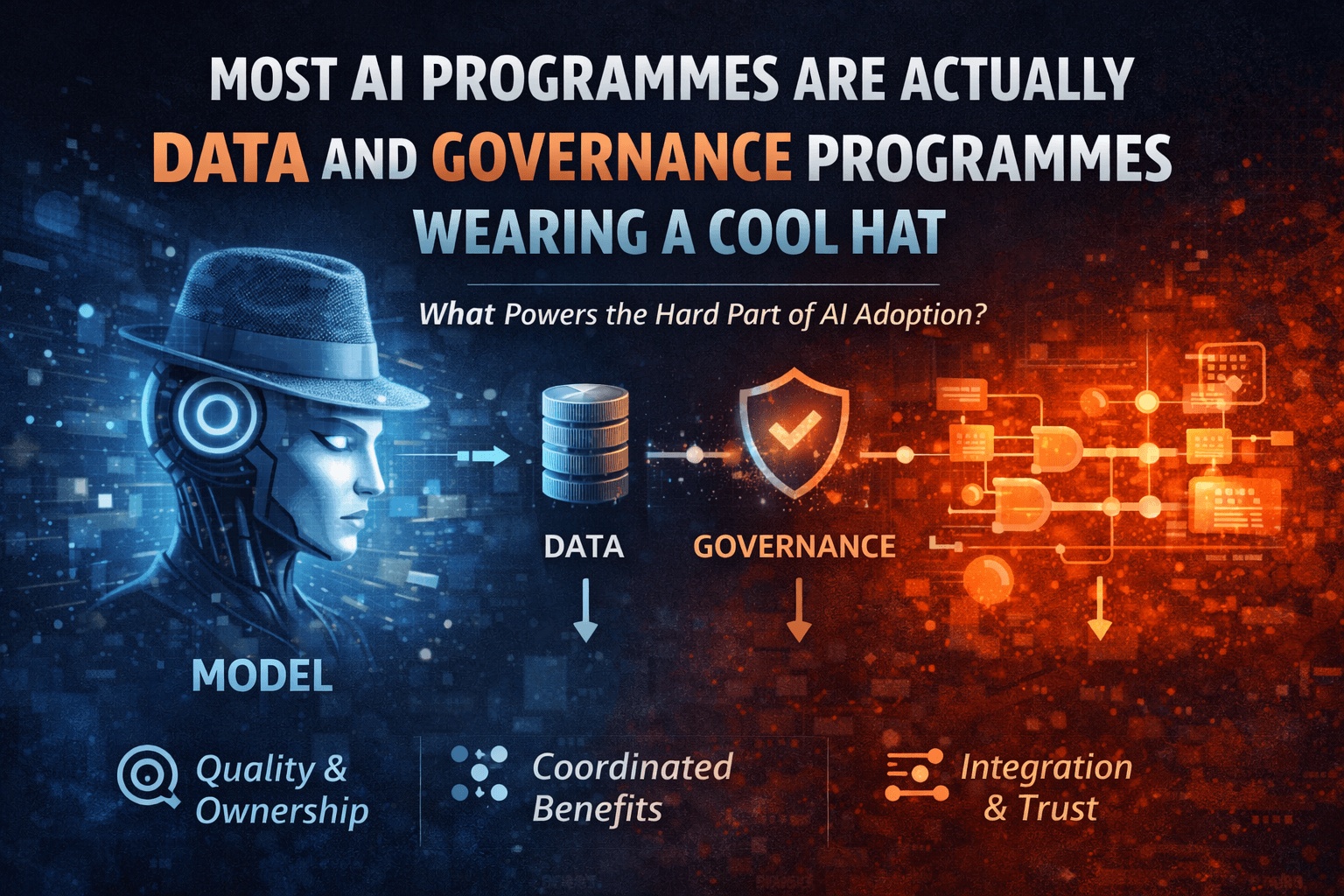
In practice, many AI programmes become what they were always going to be: data and governance programmes that AI happened to fund.
Understanding why this happens requires looking at how AI investments are typically evaluated.
AI demos are extraordinary.
A capable model summarises complex documents instantly, answers detailed questions fluently, and generates plausible outputs in seconds. The experience feels coherent, intelligent, and close to magical.
In executive environments where technology investment decisions are made, that experience translates extremely well.
The gap between the demo and production often looks like an implementation detail.
It isn't.
It is the entire substance of the programme.
The demo works because it is running on curated data in a controlled environment. The inputs are clean. The integrations are pre-prepared. The governance questions are temporarily invisible.
The demo works because it has been prepared to work.
The production environment is something else entirely. It reflects the accumulated consequences of years of organisational decisions about systems, data architecture, ownership models, and governance frameworks.
When the AI programme meets the production environment, it meets the real organisation.
And the real organisation is rarely as clean as the demo.
Once organisations move beyond the demonstration phase, the hard problems appear quickly. They tend to cluster around a few recurring themes.
AI systems depend on large volumes of reliable data.
What they often find is data that exists but was never designed for this purpose. Fields are used inconsistently across business units. Historical records contain errors that were never corrected because they didn't matter for the original system.
Definitions differ between systems in ways nobody formally documented.
Fixing this is not an AI problem. It is a data management problem involving stewardship, agreed definitions, and sustained effort. It is also often a political problem.
Agreeing on a single definition of something as simple as “customer”, “project”, or “risk” can expose disagreements that have existed quietly between departments for years.
Who owns the data feeding the model?
Who is responsible when that data is wrong? Who has the authority to change the definition or correct the source?
These questions sound administrative. They are actually foundational.
An AI system operating on data that nobody truly owns will degrade over time. Errors become difficult to trace. Trust erodes quickly.
Data ownership is not a post-deployment tidy-up task. It is a prerequisite for sustainable AI.
When an AI system makes a recommendation — or makes a decision — someone remains accountable for the outcome.
Models do not hold accountability.
People and organisations do.
That means every consequential AI system requires a clear chain of human responsibility: who defined the objective, validated the training data, approved the logic, monitors for drift or bias, and intervenes when the system produces an unexpected result.
Building that chain is governance work. It involves policies, controls, roles, and oversight structures that many organisations have not yet developed.
AI systems rarely operate in isolation. They need to consume data from existing systems and often write outputs back into operational platforms.
Those systems were rarely designed for this.
APIs may be incomplete. Documentation may be outdated. Data models may reflect architectural decisions made years ago.
Integration becomes slow, complex, and surprisingly expensive. Yet it is unavoidable. AI systems that cannot reliably ingest current data or surface outputs inside the tools people actually use quickly become ignored.
Even technically successful AI deployments fail if users do not trust the outputs.
Trust comes from explainability, reliability, and track record. Users need to understand — at least broadly — why the system produced the output it did.
Trust is built gradually through consistent performance. It is destroyed quickly when systems are presented as infallible and then fail visibly.
An AI capability that is technically impressive but organisationally distrusted rarely changes behaviour.
None of these challenges are new. Most technology leaders recognise them.
Yet AI programmes continue to run into the same obstacles.
Part of the reason is structural.
AI generates excitement, executive attention, and competitive framing. Data governance programmes do not. An AI investment looks like innovation. A data quality initiative looks like maintenance.
The political economy of technology investment consistently favours the capability that can be demonstrated over the infrastructure that makes it sustainable.
There is also an incentive problem.
The teams proposing AI programmes are rarely the same teams responsible for data infrastructure or governance frameworks. Their success is measured on delivering capability, not on fixing the organisational foundations beneath it.
And finally, the problems themselves are genuinely difficult.
Data ownership questions cross organisational boundaries. Governance frameworks require senior accountability. Integration constraints expose legacy architectural decisions that are expensive to change.
These are leadership decisions as much as technology ones.
Organisations making genuine progress with AI deployment tend to structure their programmes differently.
They treat data readiness as a go/no-go condition rather than a parallel workstream. If data ownership, provenance, and quality cannot be clearly explained, the deployment does not proceed.
They build governance frameworks early. Model oversight, auditability, human accountability, and ethical guidelines are designed into the system rather than retrofitted after something goes wrong.
They resource the unglamorous work properly. Integration, data engineering, and master data management are not treated as secondary tasks. They are recognised as the majority of the effort required to move AI into production.
And they are honest with sponsors about the shape of the journey. The capability demonstrated in the boardroom is real. The path to production is longer, slower, and more dependent on organisational decisions than the demo suggests.
Sponsors who understand this make better prioritisation decisions.
For CIOs, data leaders, and transformation sponsors, one reframe is particularly useful.
Stop thinking of AI as a technology programme that happens to depend on data and governance.
Start thinking of it as a data and governance programme that AI has finally given you the mandate to fix.
The investment, attention, and urgency surrounding AI are real. They create an opportunity to address the structural issues — fragmented data ownership, weak governance, inconsistent definitions — that organisations have deferred for years.
AI did not create those problems.
But it has made them impossible to ignore.
The organisations that use AI as the forcing function for improving data and governance maturity will build AI capabilities that are genuinely sustainable.
The organisations that treat AI purely as a technology deployment will produce impressive demonstrations and fragile production systems.
The hat is cool.
But it is the infrastructure underneath it that determines whether anything actually works.
What has been the hardest part of AI adoption in your organisation — technology, data, or governance?
And was that the part you expected when the programme began?