Change Management · Portfolio Leadership · For Executives, HR Leaders & Programme Sponsors
When a workforce is exhausted by change, most organisations look at their people.
They run engagement surveys. They launch resilience programmes. Leaders talk about building adaptability.
Six months later the same thing happens again: another initiative stalls, another programme struggles to land, and the diagnosis is repeated.
“The organisation is experiencing change fatigue.”
But here is the uncomfortable truth that rarely makes it into the boardroom conversation:
Transformation fatigue is almost never a people problem.
It is a portfolio design problem.
It is created by overloaded portfolios, poor sequencing, conflicting initiatives and weak executive alignment. And the accountability for that sits squarely at leadership level.
Blaming the workforce for change fatigue is like blaming passengers when a train derails.
Someone designed the timetable.
Someone approved the track conditions.
Someone decided to run three trains on a single line.
That is where the real diagnosis belongs.
In most organisations, fatigue does not come from the volume of change alone.
It comes from the way change is designed.
If transformation fatigue is showing up in your organisation, it almost always traces back to one or more structural issues.
Too many initiatives running at the same time, competing for the same people, budget and leadership attention.
On a portfolio slide this looks ambitious.
Inside the organisation it looks like chaos.
When everything is a priority, nothing is.
Initiatives launched before the foundations are ready.
Technology deployed before the process has been redesigned.
Culture change demanded before the strategy is understood.
Operating model changes introduced before governance is clarified.
Poor sequencing creates confusion, rework and the persistent feeling that nobody actually planned the order of events.
Different programmes asking the organisation to move in different directions.
Two transformation efforts targeting the same teams.
Different steering groups pushing different narratives.
Multiple change initiatives competing for the same middle management layer.
This is not transformation.
It is organisational noise.
Programmes approved but not actively protected.
Leaders who support transformation in town halls but revert to legacy behaviours when operational pressure rises.
Senior teams that privately disagree on priorities while publicly signalling alignment.
Organisations notice these contradictions quickly.
People believe what leaders do, not what they say.
When employees experience overlapping initiatives, shifting priorities and contradictory messaging, fatigue is not a psychological weakness.
It is a rational response to an irrational environment.
The organisations that successfully deliver large transformation portfolios do not do so because their people are unusually resilient.
They do it because their portfolios are designed well.
Dependencies are visible.
Leadership priorities are clear.
Sequencing is deliberate.
And the organisation's capacity for change is treated as a finite resource.
When the architecture is broken, no amount of resilience training fixes it.
One group consistently absorbs the consequences of poorly designed transformation portfolios.
Middle managers.
When change portfolios become overloaded, middle managers become the human shock absorbers of the system.
They translate unrealistic timelines into operational plans.
They reconcile contradictory instructions from different programmes.
They attend governance forums for initiatives they barely had time to understand.
At the same time they are expected to keep the business running.
The result is predictable.
In many transformations it is not frontline employees who disengage first — it is the management layer trying to make sense of the strategy while executing it.
When that layer burns out, transformation momentum collapses soon after.
If middle managers are exhausted, the problem is rarely below them.
It is almost always above them.
Many organisations treat portfolio management as an administrative PMO function.
In reality, it is a leadership discipline.
Effective transformation portfolios require executives to make active judgements about how much change the organisation can realistically absorb.
That means asking uncomfortable questions:
These are not operational questions.
They are board-level questions.
And the fact they are rarely discussed at that level explains a great deal about why transformation programmes stall.
One of the most overlooked capabilities in transformation leadership is sequencing.
The order in which change happens shapes how people experience it.
Well-sequenced change builds confidence. Each stage feels like a logical step forward.
Poorly sequenced change creates permanent disruption — a sense of constantly being halfway through something that never quite lands.
Good sequencing requires discipline.
It means saying:
We will not start this initiative until the foundations for it exist.
That discipline often clashes with organisational impatience and political pressure. But without it, portfolios become unstable.
And unstable portfolios create fatigue.
Organisations that deliver transformation without burning out their workforce tend to share a few characteristics.
Their portfolios are actively curated, not simply approved.
New initiatives are assessed not only on their business case but on their cumulative impact on the organisation.
Change capacity is considered before additional workstreams are launched.
Dependencies between programmes are visible and managed. Sponsors actively remove blockers rather than appearing only in governance meetings.
And when circumstances shift, portfolios adjust.
Initiatives are paused.
Scopes are reduced.
Timelines are reset.
Instead of expanding expectations while leaving the organisation to absorb the consequences.
Treating change fatigue as a workforce problem is convenient.
It shifts the conversation toward engagement, resilience and culture.
But transformation fatigue is usually the organisation telling you something much simpler:
The architecture of change is broken.
Fixing that architecture requires leaders willing to look honestly at their portfolio.
To examine the cumulative impact of decisions made across programmes.
And to treat change design with the same rigour applied to financial planning or operational capacity.
Because if transformation is strategic — if it genuinely matters — then it deserves to be designed well enough to succeed.
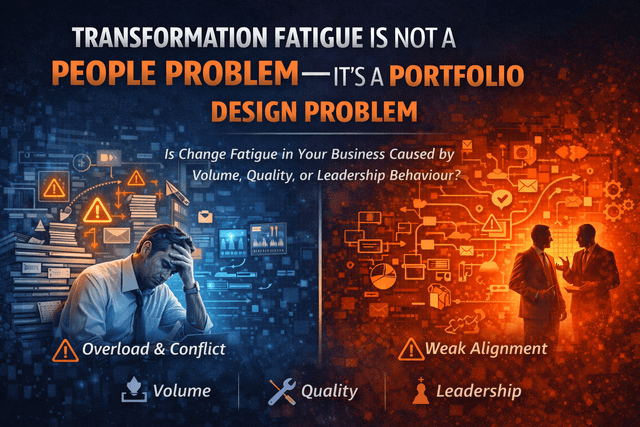
Is change fatigue in your organisation caused by volume, quality, or leadership behaviour?
Most organisations already know the answer.
They just have not said it out loud yet.
Tags: Transformation · Change Fatigue · Portfolio Management · Executive Leadership · PMO