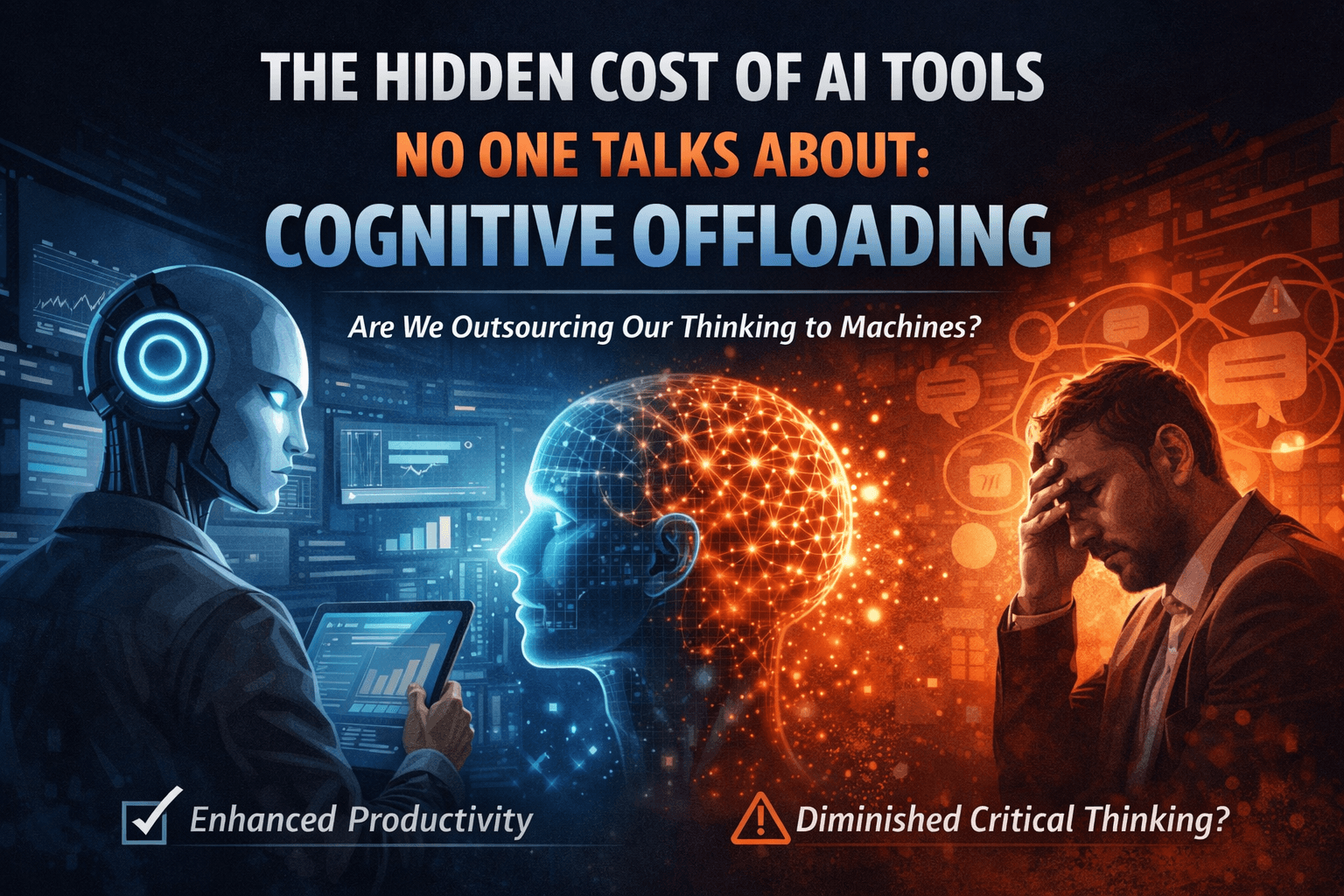
AI tools promise relief from cognitive overload. They summarise, suggest, prioritise and explain. In environments already saturated with information, this feels like progress. Yet beneath the productivity gains sits a quieter effect that is rarely discussed.
Cognitive offloading changes how people think.
When systems routinely perform tasks that once required effort, skills atrophy subtly. This is not new. Navigation apps reduced our ability to orient ourselves. Spellcheck altered how we remember words. What is different with AI is the scope of what is being offloaded. Reasoning, synthesis and even judgement are increasingly shared with machines.
In delivery environments, this shows up in small but significant ways. Teams rely on AI-generated summaries rather than engaging with source material. Risks are accepted or dismissed based on recommendations rather than debate. Decisions feel faster, but thinner. Over time, the muscle memory of critical thinking weakens.
This does not mean AI should be avoided. It means it should be used deliberately.
The danger lies not in assistance, but in substitution. When AI becomes the default first step rather than a second opinion, people stop forming their own view. They become validators instead of thinkers. This is particularly risky in complex, ambiguous situations where context matters more than pattern matching.
Leaders play a crucial role here. The way AI tools are introduced signals how they should be used. If speed is rewarded above understanding, cognitive offloading accelerates. If curiosity and challenge are encouraged, AI becomes a partner rather than a crutch.
There is also an organisational responsibility to design systems that keep humans meaningfully engaged. Explanations should be visible. Assumptions should be inspectable. Space should exist for disagreement, even when the machine sounds confident.
Nagrom’s approach to intelligent delivery tooling reflects this balance. The goal is not to remove thinking from the system, but to support it. AI can reduce noise and surface insight, but it should never close the conversation.
The hidden cost of AI is not loss of jobs, but loss of judgement. Avoiding that outcome requires intention, humility and leadership. The organisations that get this right will not just move faster. They will think better, even in the presence of machines that think with them.