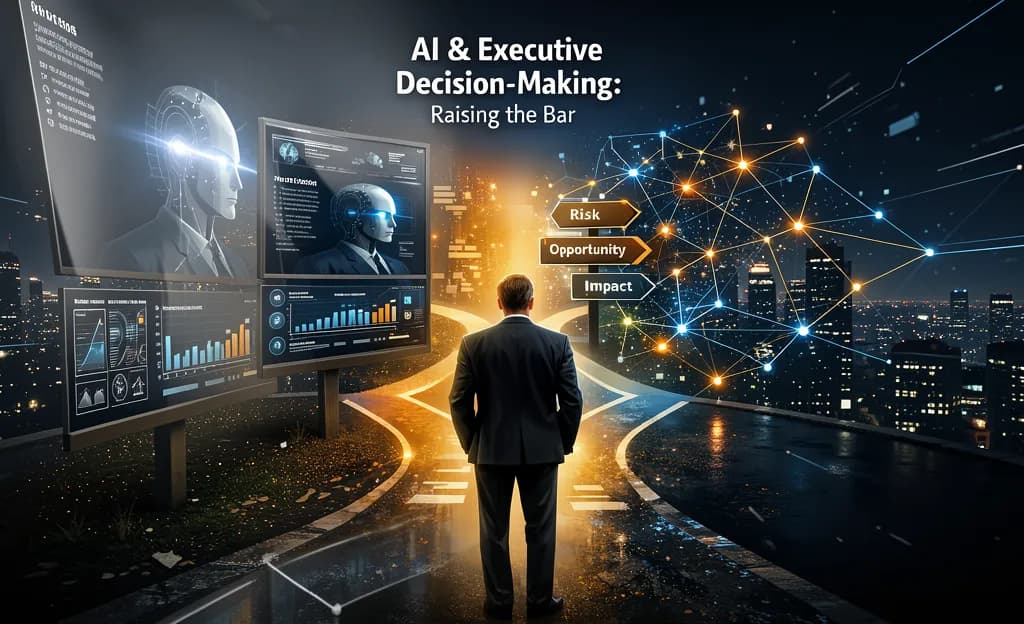
There is a persistent anxiety among senior leaders that AI will eventually render their judgement redundant. If systems can model scenarios, predict outcomes and optimise decisions, what remains for humans to do? This concern misunderstands both the nature of executive decision-making and the limits of intelligence.
AI excels at optimisation within defined parameters. Executive decisions rarely operate within such boundaries.
At senior levels, decisions are rarely about choosing the best option from a clear set. They are about defining the options in the first place. They involve incomplete information, conflicting incentives, political realities and long-term consequences that cannot be modelled with confidence. AI can inform these decisions, but it cannot own them.
What AI does change is the level of scrutiny those decisions can withstand. Assumptions that once went unchallenged are now visible. Risks that were previously hidden behind optimism surface early. Alternative paths can be explored quickly, exposing trade-offs that might otherwise have been ignored.
This raises the bar for leadership.
Executives can no longer rely on narrative alone. When systems provide counterfactuals and probabilistic forecasts, decisions must be defended in terms of intent rather than certainty. The question shifts from “are we right?” to “are we comfortable with the risks we are consciously taking?”.
There is also a cultural impact. AI reduces the distance between decision and consequence by shortening feedback loops. Leaders see the effects of strategic choices sooner, sometimes uncomfortably so. This can feel destabilising in organisations used to long horizons and delayed accountability.
Those who adapt tend to lean into transparency. They treat AI insight as a tool for dialogue rather than validation. They invite challenge, using data to explore disagreement rather than shut it down. In doing so, they reinforce trust rather than erode it.
Nagrom’s perspective on executive decision support reflects this balance. Intelligence is most valuable when it sharpens responsibility rather than diffusing it. AI should make leadership harder in the right ways, not easier in the wrong ones.
Executive judgement is not being replaced. It is being tested more rigorously than ever before. Leaders who embrace that challenge will find that AI amplifies their impact rather than diminishing it.